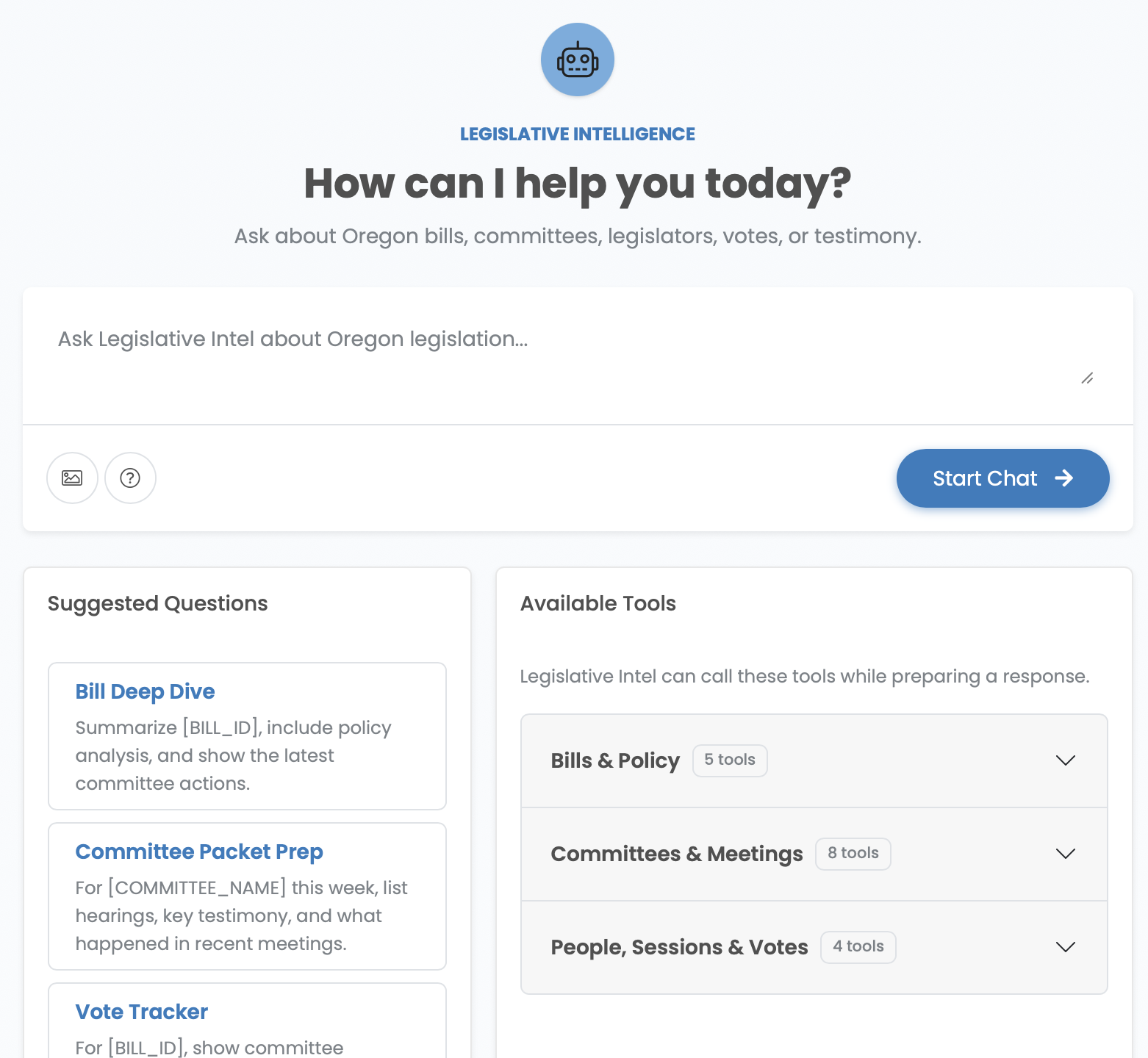
 Legislative Intel
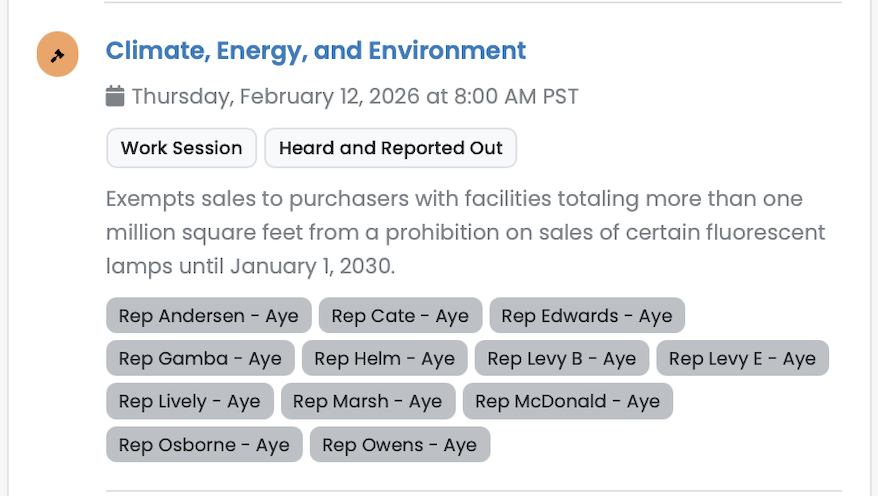
Hearings, work sessions, and adopted amendments shape the real trajectory before the formal status tells the story.
Oregon-first legislative intelligence
Oregon Legislative Monitoring, Rebuilt for Client Work.
Automatic, client-aware bill tracking, committee intelligence, and real-time impact analysis for lobbyists, legislative staff, and journalists working in Salem.
Real-time alerts
Amendment impact analysis
Committee-aware workflow
Client impact surfaced
HB 3187 now affects municipal utilities after the latest amendment.
New Amendments
Changes to HB 3187 have shifted priority for three clients.
The Shift
Bill tracking with intelligence services.
Oregon does not move on status updates alone. It moves in committee rooms, through late fiscal notes, and around amendments that change the real-world outcome.
Most trackers show calendars and bill numbers. Legislative Intel is designed to monitor what changed,
why it matters, and which clients need attention first.
A technical-looking change can alter industry exposure, municipal costs, or political viability within hours.
Budget exposure, revenue estimates, and funding assumptions can determine whether a proposal is viable at all.
Core Difference
Pro-active monitoring that thinks in client terms.
Instead of forcing you to search and manually filter hundreds of measures, Legislative Intel continuously analyzes bill language, amendments, fiscal notes, revenue impacts, and committee activity to surface proposals that may matter to your clients.
- Bills are evaluated for impact, not just keyword matches.
- Amendments are re-checked as they land.
- Fiscal and revenue changes shift priority automatically.
- Deep links take you to analysis, not a raw document dump.
Automatic Client-Aware Tracking
Review a prioritized queue, not a raw legislative feed.
The homepage draft calls for client-aware monitoring, impact scoring, and filtered review. This section uses a tabbed workflow adapted from the Silicon SaaS landing pages.
Start with the bills that actually matter.
Describe a client once. The system monitors new measures, committee agendas, amendments, and fiscal artifacts against that profile in the background.
- Client descriptions can anchor industry, geography, and policy interests.
- Measures get revisited when new legislative text changes the likely impact.
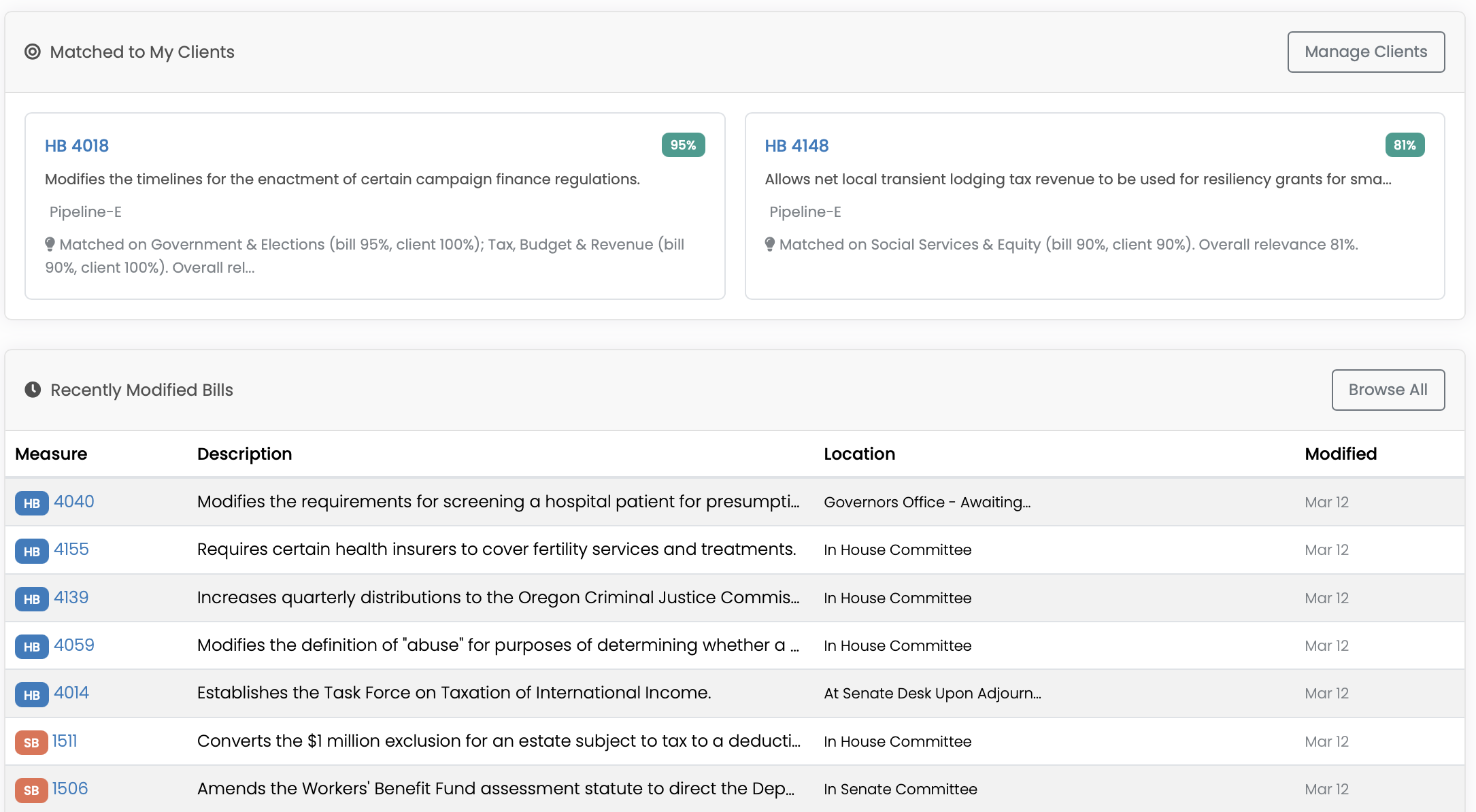
Automatic client assignment.
Legislative Intel is built around multi-client work. Bills are attached to the clients they affect, and internal nicknames keep the dashboard aligned with how your team actually talks.
- Flag likely impact before a user has time to manually read every proposal.
- Keep internal naming and team context close to the tracked bill.

Priority shifts when the facts change.
A new fiscal note, revenue estimate, or committee amendment can change the urgency immediately. The queue updates to reflect the new exposure.
- See why a bill moved up the list instead of hunting through procedural history.
- Separate background noise from real session risk during fast-moving days.

Produce client-ready summaries faster.
When something changes, the platform turns structured analysis into internal notes and client-facing brief material instead of another unread pile of source documents.
- Summaries include policy intent, stakeholder effect, fiscal exposure, and committee status.
- Designed for professionals who need to explain the impact, not just report the status.

Committee Intelligence
Know what happened without sitting through every meeting.
Traditional trackers tell you that a hearing or work session was scheduled. Legislative Intel is aimed at telling you what happened, what changed, and what that means for the affected client or issue.
- Hearings and work sessions summarized in structured language.
- Adopted amendments, vote outcomes, and discussion points surfaced together.
- Useful when you missed the room or chose not to sit through the full meeting.
Hearings
Track when testimony lands, which issues were raised, and which follow-up items matter.
Work sessions
Summarize amendments, recommendations, and the practical direction of travel.
Fiscal context
Tie the conversation back to fiscal notes, revenue statements, and budget exposure.
Decision support
Give staff, lobbyists, and journalists a clean recap while the rest of the building is still reacting.
Workflow Feature
Bill nicknames that match the way teams actually work.
HB 4000 is not how most teams talk about the bill once session pressure sets in. Legislative Intel keeps internal nicknames and shared context close to the underlying measure so the dashboard reflects real working language.
Structured Analysis
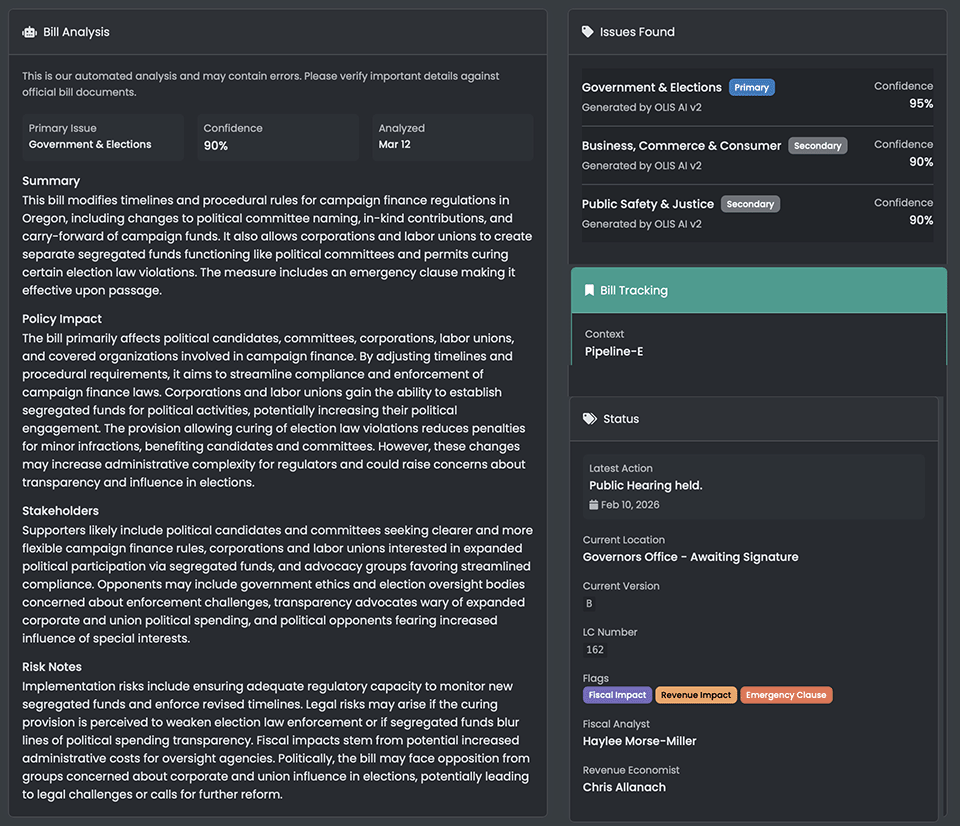
Read the short analysis instead of the 47-page packet.
Each tracked bill can surface policy intent, stakeholder implications, fiscal exposure, revenue effects, committee status, and amendment changes in one structured view built for rapid review.
Amendment & Response Support
Respond faster when bills move.
The drafting page in the public pages plan is about moving from tracking to response. The workflow below uses the Silicon steps pattern to show that progression clearly.
01
Detect the change
Monitor newly filed amendments, fiscal note revisions, and committee scheduling changes as they appear.
02
Analyze the effect
Compare the new language against the prior version, client profile, and legislative context.
03
Draft the response
Generate internal summaries and amendment language for review when timing matters during session.
04
Coordinate the next move
Hand off a structured explanation that can support client outreach, newsroom prep, or internal staff action.
Mobile Intelligence
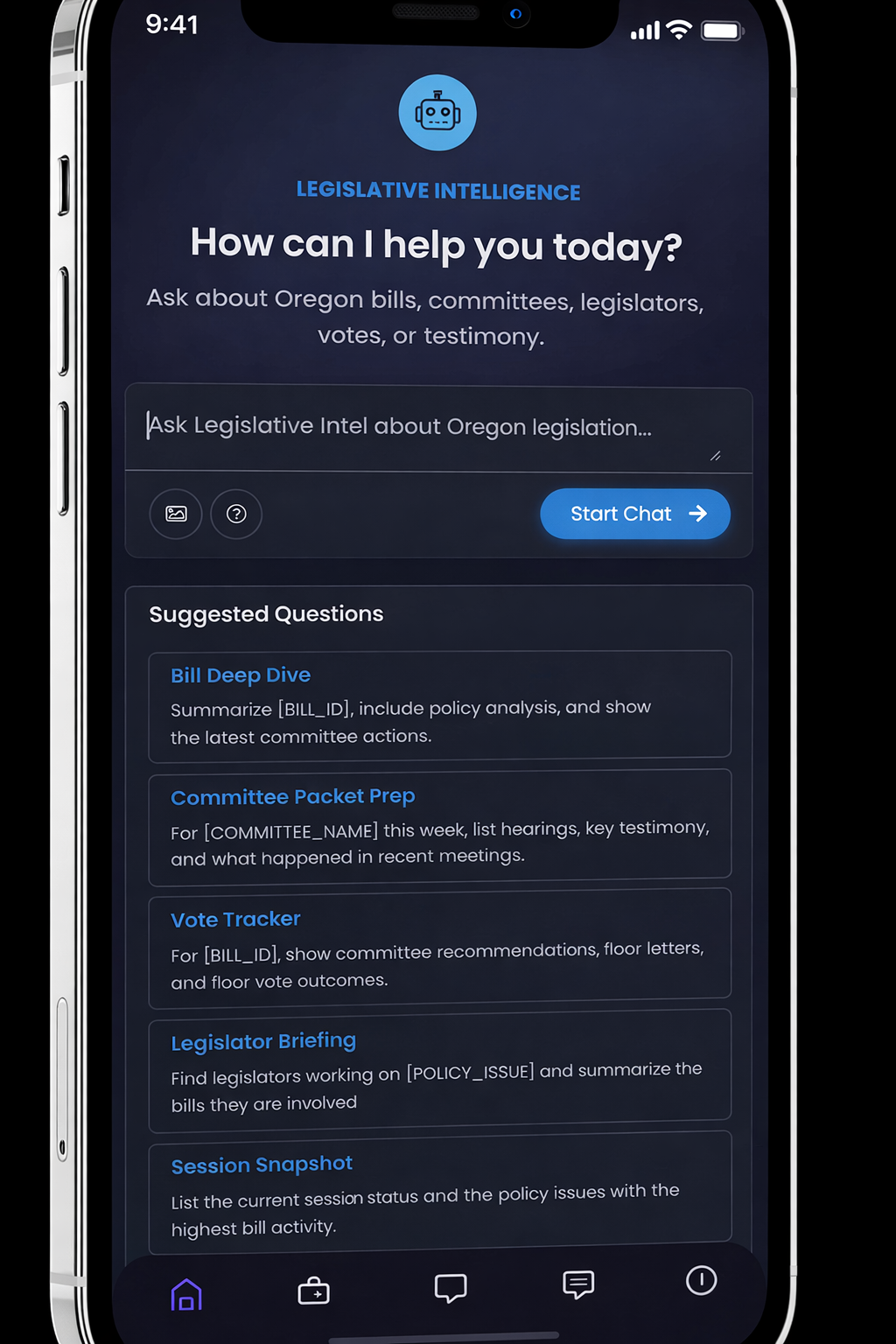
Legislative intelligence in your pocket.
When you are in the hearing room, in a Capitol hallway, or between meetings, the mobile web app should support short, high-value interactions: ask a question, check a summary, review the latest signal, or trigger a drafting request.
Ask LisaQuick questions grounded in current legislative context.
Receive alertsPriority changes surface while the day is still moving.
Check summariesPolicy and fiscal takeaways in a format suited to a hallway read.
Draft on the flyKick off a response request while the committee day is still unfolding.
Built for Oregon
Designed around how Oregon legislates.
The strongest marketing position in the public page strategy is regional depth. Lead with Oregon workflow, then layer in AI capability.
Salem workflow
Fiscal note timing
Committee discussion context
Monitor multiple clients, assign bill impact automatically, and replace the manual tracking spreadsheet.
Track issue movement, committee outcomes, and fiscal exposure without losing the procedural thread.
Translate complicated language into structured monitoring and clearer internal decision support.
See bill movement, amendments, and fiscal consequences before the broader story breaks.
Comparison
Traditional bill trackers vs. Legislative Intel.
Traditional bill trackers
- Show schedules and status updates.
- Rely on basic keyword alerts.
- Leave impact analysis and client triage to the user.
- Treat amendment changes as just another document.
Legislative Intel
- Automatic client-aware monitoring built for Oregon workflow.
- Committee outcome summaries and structured legislative intelligence.
- Amendment, fiscal, and revenue impact analysis in one review flow.
- Nicknames, prioritization, and mobile access designed for professional work.
Future feature teaser
Specific issue-level monitoring is next.
Move beyond simple keyword alerts and track nuanced domains such as urban growth boundaries, residential building codes, healthcare reimbursement, and public funding structures even when the terminology shifts.